Adaptive rain radar

On your display
Should I take rain gear today? Imber (Latin for "downpour") answers this at a glance: where the rain is around you, when it starts at your place, and how the rest of your day looks. It is not a weather report but a decision aid for the commute and the day
- Topic
- Smarthome
- Includes
- Script
Runs on
- Does not run on 32×8 (TC001 & DIY) Made for 52×16 (TC002).
- Runs on 52×16 (TC002)
- Does not run on 32×8 with AWTRIX 3 (TC001 & DIY) Made for AWTRIX NG.
Choose your display in the next step.
Script description
How to read it
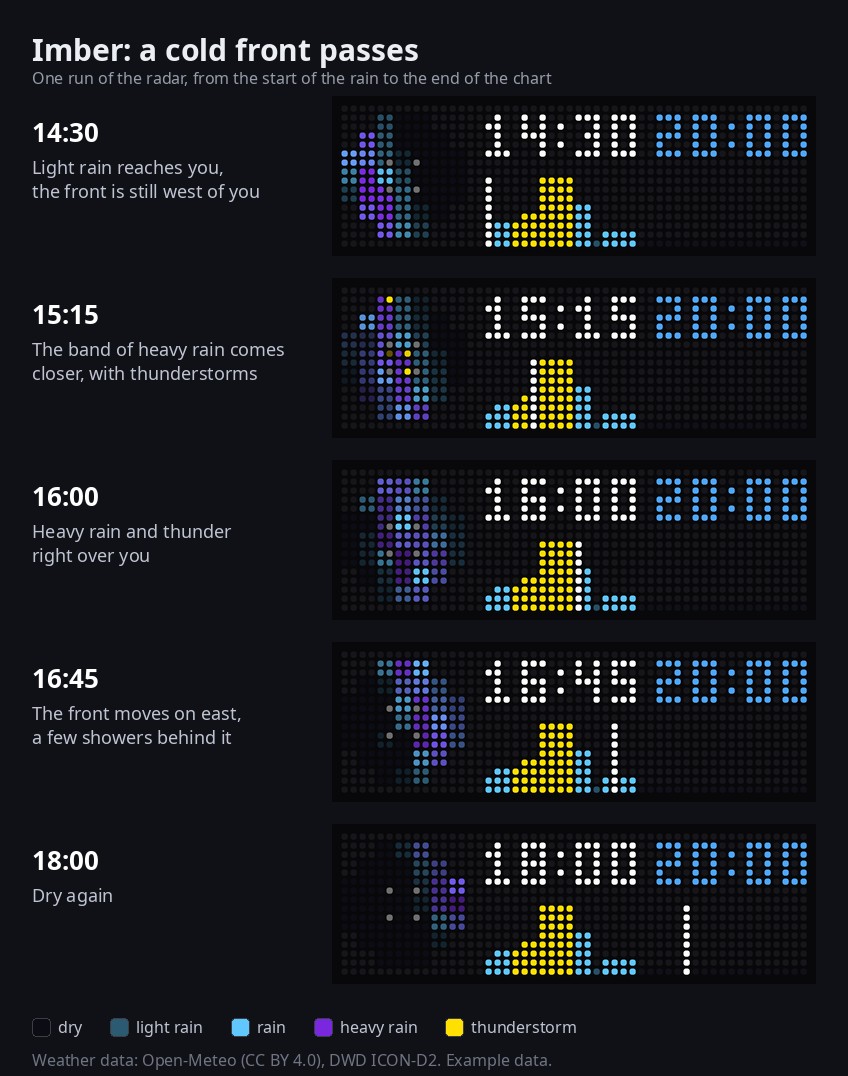
Left: the rain radar. A round map of the area around you, 20 km in every direction by default. You are in the middle, between the four grey dots. It plays the forecast hour by hour, so you see the rain move across your area: black is dry, the brighter the blue, the more rain, heavy rain is dark purple. A yellow dot marks thunderstorm potential, the brighter, the stronger.
Top right: the time window. On the left, in white, the time the radar is showing, to the quarter hour. Each run starts at the time the rain starts at your place (if it is already raining, now). On the right the time the chart ends.
Bottom right: the chart. One pixel column per slice of time between these two times. The height is the rain at your place, a yellow column means thunderstorm potential nearby. A white line runs along with the radar and shows which moment it is at.
The app only joins the rotation when rain is expected before the end of your day (20:00 by default). On dry days you never see it.
Setup
Install the script and open its settings.
Enter your latitude and longitude (decimal degrees, e.g. from a map app). The default is the centre of Germany.
Optional: adjust the map radius, the rain threshold, the end of your day and the animation length.
Optional integrations
Show only when (MQTT topic): the app only appears while this topic says on. Example: let Home Assistant publish on during your morning routine, so the forecast is on the clock when you get ready, and gone afterwards.
Indicator topic (MQTT): lights one of the clock's indicators while rain is expected today, e.g. awtrix/cmd/indicators/3 (use your own MQTT prefix).
Good to know
Data: Open-Meteo (CC BY 4.0), model ICON-D2 of the German Weather Service (DWD), about 2 km resolution, updated every hour. It covers Germany and its neighbouring countries only; elsewhere the app shows no data.
Two requests per update: hourly values for the map (one request for all 37 points) and 15-minute values for your place. With the default interval of 15 minutes this is about 3,700 location calls a day, within Open-Meteo's free limit of 10,000 for non-commercial use. Shorter intervals can exceed it.
Thunderstorms are shown by the lightning potential index (LPI) of the model. It tells how likely and how strong lightning is, but it is not a probability.
The clock needs internet access (HTTPS to api.open-meteo.com).
Made for the 52×16 display (Ulanzi TC002).
Setup guide, settings and troubleshooting: https://github.com/exradice/imber
Sign in to view and copy the code of this script.
Discussion 0
Ask a question, suggest a change or share how you use it.
No comments yet. Start the conversation.
Have an idea?
Sign in to ask questions and join the conversation.